

2024 Corporate Governance
Sustainability Performance and Corresponding SDG
| Practice SDG United Nations Sustainable Development Goals | Sustainability Performance |
|
SDG 8
Decent Work and Economic Growth
|
|
|
SDG 16
Peace, Justice, and Strong Institutions
|
|
|
SDG 17
Diverse Partnerships
|
|
Major Theme Management Policy - Corporate Governance and Integrity Management
| Item | Content Description |
| Major Topics / GRI Indicators | Corporate Governance and Integrity Management Corresponding indicators: GRI 2-9 to 2-28 (covering governance structure, nominations, compensation, integrity in operations, etc.) |
| Impact Description | ●Positive Impact:Enhance operational efficiency through a robust governance structure, strengthen decision-making transparency and oversight, and comprehensively protect shareholder rights. ●Negative Impact:Weakened decision quality will lead to a loss of trust, failing to protect the interests of stakeholders and reducing competitiveness. |
| Policies and Commitments | The "Corporate Governance Practice Code" and "Corporate Integrity Management Code" have been established, adhering to the principles of "Integrity, Service, Innovation, and Sharing" to pursue sustainable growth. |
| Management Objectives |
Short-term Goals (2025~2026)
[Medium and Long-term Goals (2027~2030)]
|
| Responsible Unit and Complaints | Responsible Unit:Administrative Management Office Complaint Mechanism:
|
| Action Plan and Evaluation | Action Plan:Implement performance evaluations for executive directors in accordance with the regulations, and promote integrity awareness training. Effectiveness Assessment:Conduct a self-assessment of the board/committee once a year; the audit unit conducts regular checks and reports to independent directors. |
__26I21jqtAo.png)
Major Theme Management Policy - Economic Performance
| Item | Content Description |
| Major Topics / GRI Indicators | Economic Performance Corresponding indicators: GRI 201-1 Direct Economic Value, 201-2 Financial Implications of Climate Change, 201-3 Pension Plans, 201-4 Government Grants |
| Impact Description | ●Positive Impact:Increase revenue and stabilize profits, create maximum shareholder value, and continuously invest in research and development resources, while maintaining customer relationships to achieve sustainable development. ●Negative Impact:Poor performance will lead to reduced investment willingness, changes in customer relationships, difficulties in talent recruitment, and increased costs of fundraising and borrowing. |
| Policies and Commitments |
|
| Management Objectives |
[Short-term Goals (2025~2026)]
[Medium and Long-term Goals (2027~2030)]
|
| Responsible Units and Actions | Authority Unit:Finance Department, Administration Department Complaints and Communication:  (Investor Email) (Investor Email)Action Plan:Continuously obtain higher profits to reward shareholders; pay attention to global political and economic situations and formulate contingency measures. |
| Effectiveness Assessment |
|
Corporate Governance
In compliance with relevant laws and regulations, the company's articles of association, and the contracts signed with the stock exchange, and based on the "Corporate Governance Practice Guidelines" issued by the competent authority, the company has established the "Corporate Governance Practice Code." The code includes five major governance principles, which are to protect shareholders' rights, strengthen the functions of the board of directors, enhance the role of supervisors, respect the rights of stakeholders, and improve information transparency, serving as the core of the corporate governance framework. The code has been announced on the company's internal website for all employees to follow.
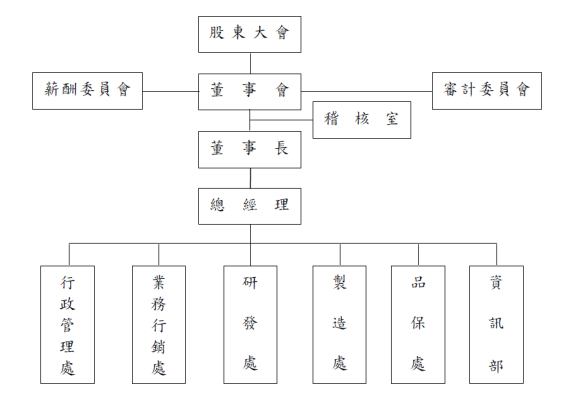
Note: The Sustainability Development Committee was established on January 7, 2025, and is a functional committee under the Board of Directors.
Composition of the Board of Directors
The new highest governance body is the board of directors, which currently has 7 directors, including 3 independent directors with professional knowledge whose shareholding and concurrent positions are restricted, and who have no direct or indirect interests with the company or its related parties.
Mr. Wu Jinchuan, the current Chairman of the Company, will not hold the position of General Manager or any executive role starting from December 2023. He will be solely responsible for presiding over board meetings, leading the deliberation of corporate governance policies and significant business decisions, and overseeing the coordination between functional committees and the management team.
According to the "Articles of Incorporation," the term of office for company directors is three years, and they may be re-elected consecutively.
The number of independent directors shall not be less than two and shall not be less than one-fifth of the total number of directors.
The methods for accepting director nominations and other compliance matters shall be handled in accordance with the relevant provisions of the Company Act and the Securities and Exchange Act. After their appointment, the directors shall, by resolution of the board of directors, purchase liability insurance for the directors to mitigate the risks associated with the performance of their duties.
The company also discloses and reviews the total shareholding ratio of all directors regularly in accordance with the regulations of the competent authority.
In 2024, the company's board of directors held a total of 6 meetings, with an average attendance rate of 95.24%. During these meetings, in addition to reviewing the annual financial report, amending internal control systems and related measures, disposing of investment cases, and making significant decisions regarding the salary adjustments and bonuses for the chairman and managers, formal reports and discussions on various sustainability-related issues were also conducted. The specific communication content is as follows:
| Meeting Date | Important ESG-related proposal content | Decision and Execution Results | Reference Information |
| 2024/11/12 | Establishing a CompanyManagement of Sustainable InformationInternal (Internal Audit) System Proposal | Approved by the board of directors, the sustainability information disclosure process will be incorporated into the scope of internal control and auditing to ensure the quality of ESG data and compliance with laws. | 2024 Annual Report (Page 32) |
For the complete minutes of the board meetings and resolutions, please refer to the annual report available for download in the company's official website.
The company's board of directors, internal audit supervisor, and accountants hold regular meetings to communicate on significant matters such as the company's financial status, business conditions, internal audit reports, quarterly carbon inventory scope one and two, board performance evaluations, employee and director compensation distribution, and the effectiveness of internal control systems.
Composition and Diversity of the New Board Members
| Job Title | Name of the Director | Gender | Age | Concurrent Company Employee | Years of Service for Independent Directors | Industry Experience and Educational Background | Professional Competence | ||||||
| semiconductor | Investment | Bank Securities | Financial Accounting | Business Management | Industry Knowledge | Legal Affairs | |||||||
| Legal Representative - Chairman | Wu Chin-chuan | Male | 61 to 70 years old | No | - | Doctor of Electrical Engineering, Carnegie Mellon University, USA
|
V | V | V | ||||
| Legal Representative - Director | Hsieh Yu-ju | Female | 51 to 60 years old | No | - | Master of Business Administration, Waseda University, Japan
|
V | V | |||||
| Corporate Director Representative - Director | Hsieh Yi-wang | Female | 41 to 50 years old | No | - | Master of Business Administration, University of California
|
V | V | |||||
| Director | Yao Hsu-chieh | Male | 41 to 50 years old | No | - | Master of Business Administration, Massachusetts Institute of Technology, USA
|
V | V | V | ||||
| Independent Director | Chen Shih-hsin | Male | 71 years old and above | No | 3 to 9 years | Master of Business Administration from the Wharton School of the University of Pennsylvania
|
V | V | V | ||||
| Independent Director | Jian Wei Neng | Male | 61 to 70 years old | No | Less than 3 years | Bachelor of Laws from Fu Jen Catholic University, Master's degree from Tamkang University Institute of European Studies
|
V | ||||||
| Independent Director | Lin Tsung-sheng | Male | 51 to 60 years old | No | Less than 3 years | Doctor of Management, King's College London
|
V | V | V | ||||
Board Nomination and Selection
The method of selecting directors adopts a candidate nomination system, and according to the "Director Election Method", directors are elected through cumulative voting, reflecting shareholders' opinions in a fair, just, and open director selection process.
In addition to the actual participation of the chairman in the company's operational guidance, all directors (including independent directors) are external professionals with relevant industry experience and diverse backgrounds in finance and accounting.
To strengthen the functions of the board of directors, the company periodically provides directors with the latest laws and relevant regulations, and continues to promote diversity and gender balance in the board.
After being appointed, directors are insured with liability insurance to protect them from the risks of lawsuits or claims while performing their duties.
At the same time, maintain open communication with stakeholders through the company's spokesperson system and the company website.
The company implements internal control systems to ensure that all employees comply with relevant laws and regulations.
In the future, the succession planning for board members will continue to strengthen the structure of the board to meet the diversity, gender balance, age distribution, and specialization of board members.
Diversity and Independence
The company has established a board diversity policy, considering diversity in the composition of board members, the company's operations, business model, and future development needs. Members with diverse backgrounds and perspectives are selected, taking into account factors including but not limited to gender, age, nationality, culture, professional background, such as law, accounting, industry, finance, marketing, or technology, professional skills, and industry experience.
The company's board of directors has rich experience and expertise in various fields such as finance and electrical engineering. Among them, the goal is to have 5 directors with industry experience or professional capabilities in finance and accounting. By 2024, there are already 6 directors with industry experience or professional capabilities in finance and accounting.
The company emphasizes gender equality in the composition of the board members, setting a target of at least 2 seats for women.
The board composition for 2024 consists of a total of 7 directors, of which 2 are female directors, achieving the set target.
Currently, the board of directors consists of 7 directors, of which 3 are independent directors. They do not have significant transactions with the company or its related parties, do not hold important positions in the company or its affiliates, do not hold excessive shares in the company, and do not have other conflicts of interest with the company.
Avoid conflicts of interest
The company, in accordance with the "Rules of Procedure for the Board of Directors" and the "Code of Ethical Conduct," prohibits directors and managers from using their positions in the company to obtain improper benefits for themselves, their relatives, or anyone else, and avoids any actions that may create a conflict of interest with the company.
According to the Securities and Exchange Act, in addition to having at least five directors (including no less than two independent directors), directors must not be spouses or relatives within the second degree of kinship. The same restrictions on familial relationships must also apply between supervisors and between supervisors and directors to avoid conflicts of interest and excessive concentration of power. The company's board of directors currently consists of seven directors (including three independent directors), and there are no spousal or second-degree relative relationships among the directors or between directors and supervisors.
In addition, the directors uphold a high level of self-discipline. For any proposals listed by the board that may have a conflict of interest with themselves or entities they represent, they must explain the important content of such interests at the board meeting. If there is a risk of harming the company's interests, they shall not participate in the discussion and voting, and they should recuse themselves during the discussion and voting.
Directors exercise their voting rights, and directors abstain from matters in accordance with the regulations of the "Corporate Governance Best Practice Principles for TWSE/GTSM Listed Companies".
Board Performance Evaluation
To strengthen the governance functions of the company and the effectiveness of the board of directors, the company has established the "Board Performance Evaluation Measures," which conducts an annual performance evaluation of the board of directors, individual board members, and functional committees using a questionnaire method.
The scope of the evaluation includes the overall board of directors, individual board members, and the performance evaluation of functional committees.
The evaluation methods include internal self-assessment by the board of directors, self-assessment by board members, peer evaluation, appointing external professional organizations, experts, or other appropriate methods for performance evaluation.
However, the evaluation indicators cover the board's level of participation in the company's operations, decision-making quality, the appointment of directors and their continuing education, as well as the implementation of internal controls.
Each individual board member conducts a self-assessment based on their understanding of the company's goals and mission, awareness and execution of responsibilities, level of participation in operations, management and communication of internal relationships, professional competence and continuous education, as well as compliance with internal controls, and a comprehensive evaluation is conducted by the board.
Through various assessment indicators, understand the level of agreement among directors regarding the operation of the board and functional committees, serving as a reference for future continuous improvement.
The performance evaluation of the board of directors, board members, and functional committees was completed in January 2024. The results of the performance evaluation were reported to the board in March 2024. Based on the total score for each question and the ratio of the total score for all questions, the weighted score of the evaluation falls within the range of 80% to 100%.
The rating is classified as "Excellent", indicating that the overall operations of the company's board of directors, audit committee, and compensation committee are good.
Performance Evaluation Metrics for the Board of Directors and Functional Committees
| Board of Directors Performance Evaluation Measurement Items |
Board Members (Self or Peers) Performance Evaluation Measurement Items |
Functional Committee Performance Evaluation Measurement Items |
|
|
|
Board Compensation Policy and Decision-Making Process
The company has established a Compensation Committee under the Board of Directors, currently composed of 3 independent directors. With a professional and objective stance, the committee evaluates the compensation policies, systems, standards, and structures for the company's directors and managers. In the evaluation process, the Compensation Committee references the typical compensation levels in the industry, considers individual performance, the company's operational performance, and the reasonableness of future risk correlations, and submits specific recommendations to the Board of Directors for decision-making reference. The committee also conducts regular internal performance evaluations annually.
According to the "Articles of Incorporation," when directors perform their duties, they may receive appropriate compensation regardless of the company's profit or loss. The compensation is determined by the board of directors based on the extent of each director's participation in the company's operations and the value of their contributions, taking into account the usual standards in the industry.
In addition, during the company's annual profits (based on pre-tax profits before deducting employee and director compensation), at least 1% of the profits must be allocated for employee compensation, and no more than 2% of the profits for director compensation, and distributed according to relevant regulations.
To the new 2024 board members' continuing education status
Board members, upon their appointment or during their term, continuously participate in training courses organized by designated institutions under the guidelines for the continuing education of directors and supervisors of listed companies, covering topics related to corporate governance, finance, risk management, business, commerce, accounting, law, or corporate social responsibility. In 2024, board members participated in training courses such as the "2024 Cathay Sustainable Finance and Climate Change Summit Forum," "Corporate Governance and Securities Regulations," "Corporate ESG Practical Topics: Legal Responsibility Cases of Gender Equality and Human Rights," and "Legal Analysis of Corporate Control Disputes," totaling 15 hours, to enhance their professional and legal knowledge related to sustainability.
| Course Name | Number of Board Participants | Total Training Hours for Directors (hours) |
| 2024 Cathay Sustainable Finance and Climate Change Summit | 1 | 6 |
| Corporate Governance and Securities Regulations | 1 | 3 |
| Corporate ESG Practical Topics: Legal Responsibility Cases of Gender Equality and Human Rights | 1 | 3 |
| Legal Responsibilities and Case Analysis Related to Company Control Contests | 1 | 3 |
Functional Committee
The new board of directors has three functional committees, including the Audit Committee, the Compensation Committee, and the Sustainability Committee established on January 7, 2025.
The Audit Committee consists of three independent directors, with a term of three years. The members elect one independent director to serve as the convener and chair of the meetings.
The main responsibilities of the Audit Committee are to fulfill supervisory duties, assess operational performance, and resolve important matters, and to conduct annual internal performance evaluations of the Audit Committee.
The main responsibility of the Compensation Committee is to evaluate the compensation policies, systems, and standards for directors and executives, and to propose revisions or adjustments to the board of directors.
The term of committee members is three years, with no fewer than three members, and must include at least one independent director, who shall be elected by all members to serve as the convener.
The Sustainability Development Committee consists of the Chairman and two Co-CEOs, totaling three members, who primarily promote the company's sustainability-related work.
The Sustainability Development Committee has a Sustainability Management Team responsible for compiling and preparing the sustainability report, which is then reviewed and approved by the Sustainability Development Committee before being submitted to the Board of Directors for final approval.
The 2024 Sustainability Report is the company's first officially published sustainability report.
| Committee | Composition | Frequency of Meetings | 2024 Conference Number of Meetings |
Average Attendance Rate |
| Audit Committee | Composed of 3 independent directors, with a term of 3 years. All members elect one person to serve as the convener. | At least once every quarter | 5 times | 93% |
| Compensation Committee | Composed of 3 independent directors, with a term of 3 years. All members elect one person to serve as the convener. | At least twice a year | 2 times | 100% |
| Sustainability Development Committee | Established on January 7, 2025, consisting of the chairman and 2 general managers, totaling 3 members. | At least once a year | - | - |
The company established a Sustainability Development Committee in January 2025, led by the Director of the Administration Department, responsible for promoting sustainable development, monitoring changes in laws and policies, and discussing and advancing sustainable development plans with relevant departments. The committee will report to the board of directors on the status of sustainable development implementation as needed.
The main responsibilities of the committee include:
1. Formulate, promote, and strengthen the company's sustainability development policies, annual plans, and strategies.
2. Review, track, and revise the implementation and effectiveness of sustainable development.
3. Supervise sustainability information disclosure matters and review the sustainability report.
4. Supervise the execution of the company's sustainable development code of conduct or other sustainability-related work as resolved by the board of directors.
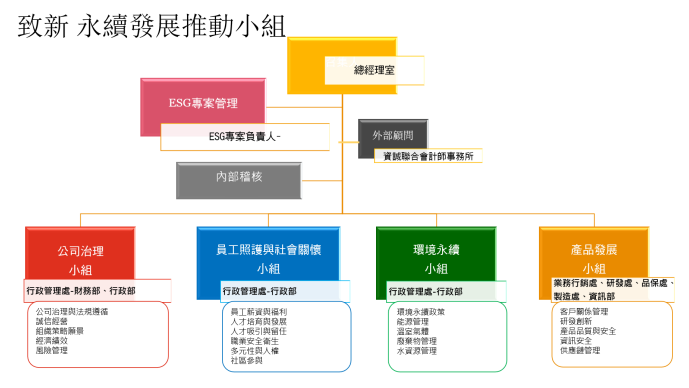
To the New Sustainability Promotion Task Force Organizational Structure
To enhance the new sustainability competitiveness and effectively promote related affairs, the company established a cross-departmental sustainability promotion team in 2024, with the general manager serving as the convener. Under this team, various sub-groups were formed based on different sustainability issues, and meetings are held periodically to review and track the progress of the short-term, medium-term, and long-term goals set by ESG, gradually achieving the company's sustainability objectives.
The Sustainability Promotion Team is composed of leaders from various groups and several members, responsible for discussing relevant sustainability topics and formulating corresponding action strategies. After being reviewed and approved by the Sustainability Development Committee, the relevant results are reported to the Board of Directors for approval, ensuring the continuous implementation of the company's ESG strategy.